
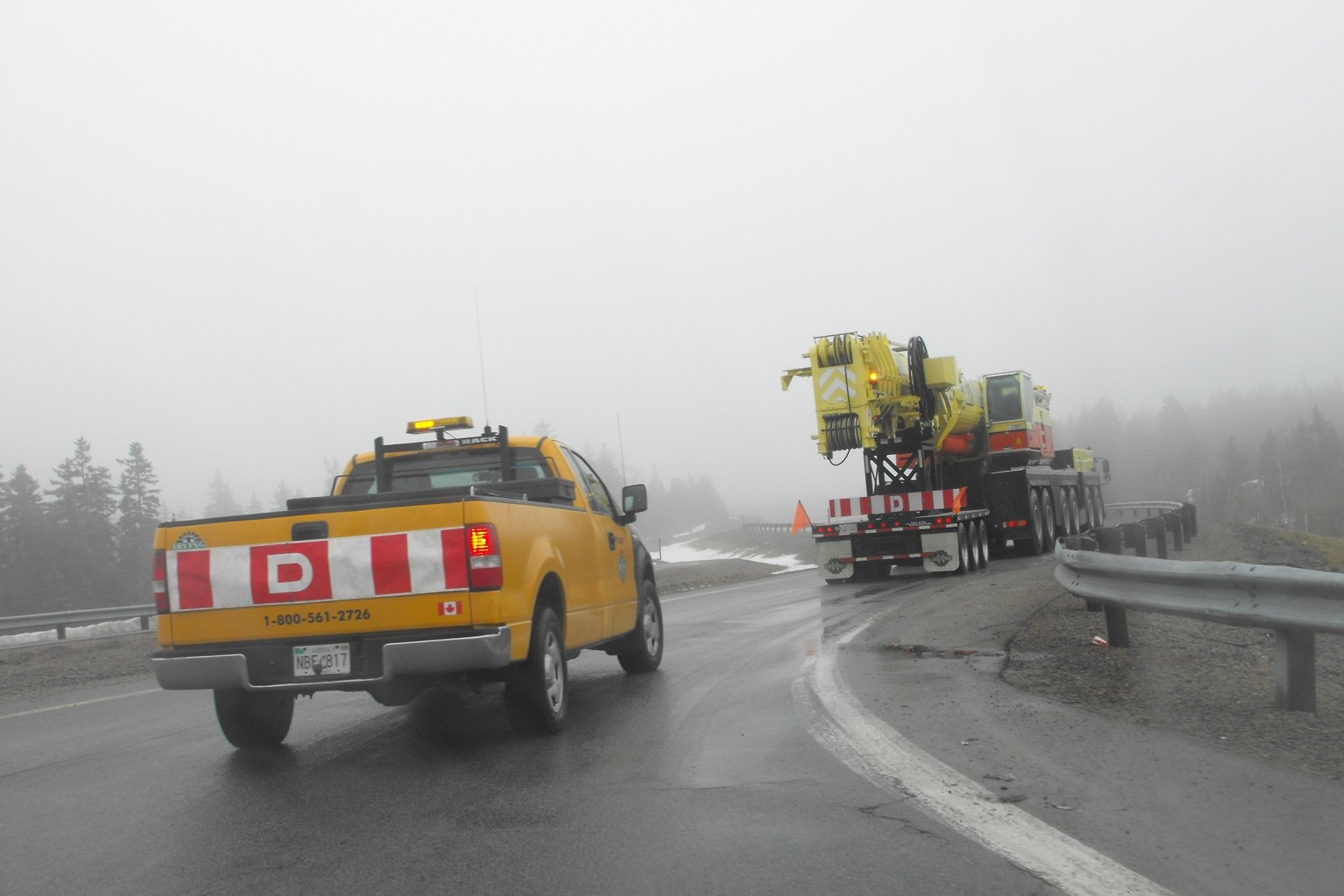
Some heavy-duty parts and equipment are too tall, too wide, or too heavy for a standard trailer. Here's how Long Road hauls oversize freight on an RGN and delivers it in one piece.
When the load outgrows the box
Most freight fits in a dry van, and for good reason. It's enclosed, it's simple, and it's cheap per mile. But heavy-duty equipment doesn't always cooperate. Sooner or later a load shows up that's too tall to clear the door, too wide to fit between the walls, or too heavy to sit safely on a standard deck. When that happens, forcing it into the wrong trailer isn't thrifty, it's a wreck waiting to happen. The load needs open-deck equipment, and often it needs the lowest deck you can get: an RGN.
RGN stands for removable gooseneck, and the name describes the trick. The front of the trailer detaches and drops to the ground, turning the deck into a ramp so a tall or rolling piece can be driven or winched straight on. Once it's loaded, the gooseneck reattaches and the whole thing rides low to the road. That low deck height is the entire point, because when a load is already tall, every inch you can drop the deck is an inch of clearance you get back under bridges and overpasses.
Why certain parts and equipment can't ride in a dry van
Height is the usual culprit. A standard trailer eats up a chunk of vertical space before you've loaded anything, so a piece that's perfectly legal on the ground can bust the legal height limit the moment it's sitting on a high deck. Drop that same piece onto an RGN's low deck and suddenly it clears. Width is the next problem. Anything wider than the standard lane needs an open deck and an oversize permit, because it simply won't fit inside walls. Then there's weight, where the concern shifts from fitting the load to spreading it, so no single axle carries more than the road and the permit allow.
For truck parts specifically, the awkward cases are the big ones. A full-size heavy-duty bumper, a one-piece hood, a wide deer guard or grille assembly, or a bulky equipment component can be too large or oddly shaped for van freight even when it isn't especially heavy. Open-deck options like flatbeds, step-decks, and RGNs exist precisely for cargo that laughs at the dimensions of a box trailer.
Permits, routes, and the paperwork amateurs skip
Oversize and overweight freight lives inside a web of rules, and every state writes its own. Once a load crosses the legal thresholds for width, height, length, or weight, it needs permits, and the permit dictates the route, the legal hours to travel, and sometimes escort vehicles or pilot cars. A load that's fine on one highway may be banned from a low bridge two exits later. Route planning isn't a formality here, it's the difference between a delivery and an expensive detour with a police escort you didn't want.
This is where a real heavy-haul team pulls ahead of an operator who occasionally straps something to a flatbed. Permitting and routing done right means the load moves during legal windows on roads that can actually take it, without a surprise stop at a scale or a bridge it was never allowed to cross. Getting that wrong doesn't just cost time, it can cost the load.
What professional heavy-haul care looks like
- The right trailer for the load — flatbed, step-deck, or RGN lowboy for the tall and heavy pieces
- Proper permits pulled for width, height, length, and weight before the wheels turn
- Routes planned around bridge heights, weight limits, and legal travel hours
- Load secured to standard with the right chains, straps, and blocking so nothing shifts
- Escort or pilot vehicles arranged when the dimensions call for them
- Communication from pickup to delivery so you know where an oversize load stands
The care an oversize load actually demands
Securing open-deck freight is a craft. Unlike a van load that's contained by walls, an oversize piece on an open deck is held only by what the crew puts on it, and it faces wind, road vibration, and every bump between origin and destination. The right number of chains and straps at the right angles, blocking to stop it sliding, and tarping when the cargo needs protection from the weather are all judgment calls a seasoned crew makes without thinking. Do it casually and an expensive part arrives scarred or, worse, comes loose on the highway.
Long Road Transportation runs oversize and heavy-haul transport as a core service, including RGN lowboy trailers for the tall and oversized loads that a dry van can't touch. That matters for PartStop, which ships large items like bumpers, hoods, grilles, and deer guards that don't always fit standard freight. When one of those oversized pieces needs to move, it goes on the right equipment, secured by people who do this for a living, and it shows up ready to install rather than ready for a damage claim.
Ship it right the first time
Oversize freight punishes shortcuts. The wrong trailer, a missing permit, or a load secured by guesswork turns a straightforward delivery into a costly mess, and the part you were counting on arrives late or damaged. The fix is simple: hand the big, tall, and heavy loads to a heavy-haul team that has the equipment and the discipline to move them properly. For PartStop's oversized parts, that team is Long Road Transportation, and the freight arriving in one piece is the whole point.
Work with our partners
For oversize and overweight loads that need an RGN, flatbed, or step-deck, Long Road Transportation has the equipment and the crew to move them right.
Get a Quote from Long Road TransportationShop related parts
Premium-quality aftermarket direct replacements — nationwide same-day shipping, 6+ month warranty.
Need the part, not just the reading?
Every part below is a Premium Quality aftermarket Direct Replacement with published OEM cross-reference numbers, a 6+ month warranty and same-business-day shipping from Tacoma, WA. Not sure it fits? Run your VIN — or call and a person who knows trucks will verify fitment before you pay.