
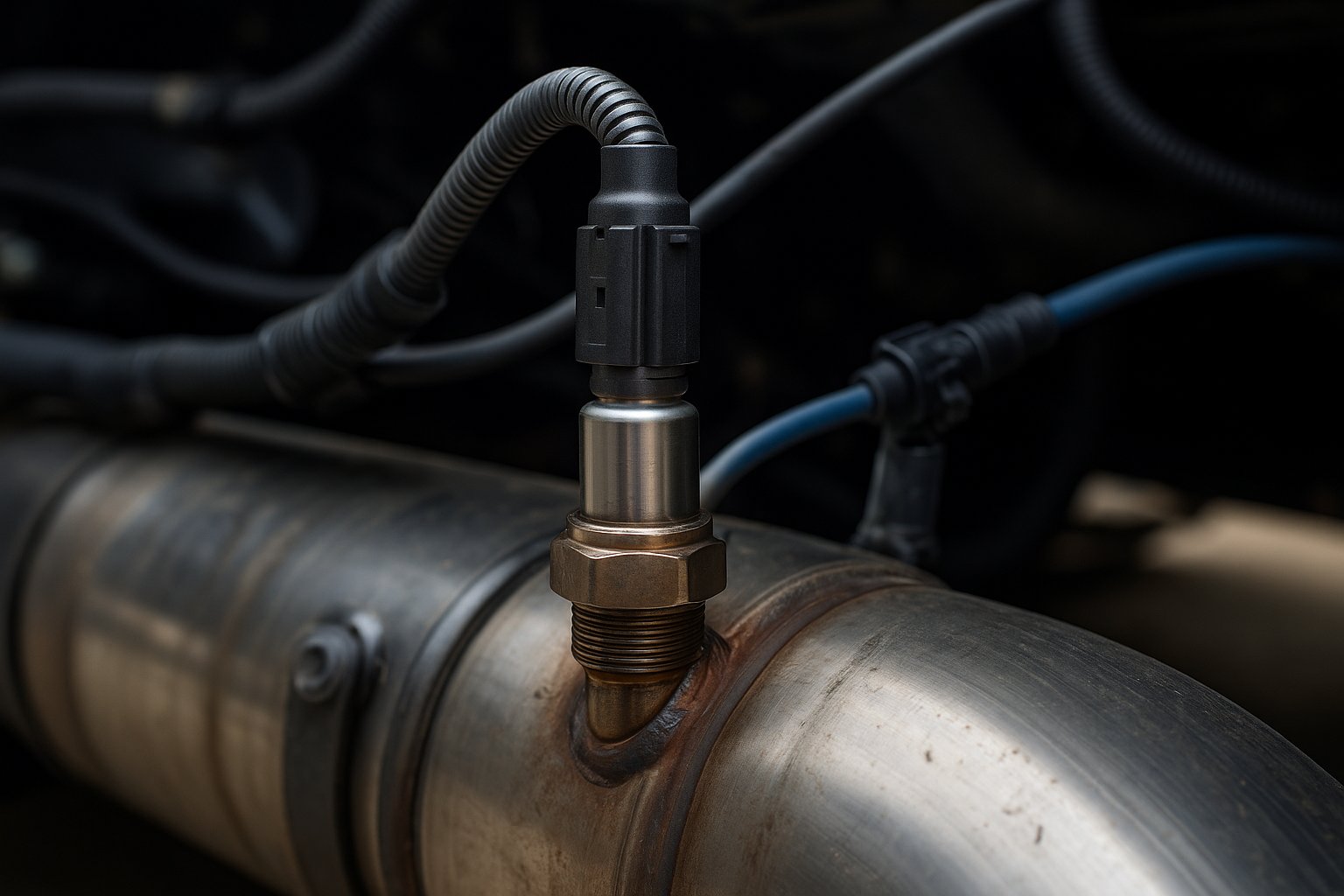
Quick answer
A failed NOx sensor is the most common cause of an aftertreatment derate: heat, soot and moisture kill the upstream or downstream sensor, the ECU can't verify SCR performance, and it limits power (sometimes to 5 mph) to protect emissions compliance. Upstream and downstream sensors are often different numbers and vary by engine — a Cascadia DD15 sensor (cross-references to A0101531828) is not a Cummins ISB 6.7L sensor (2894945 / 5WK96692A). Read the fault to identify position and match by engine.
A failed NOx sensor is the most common cause of an aftertreatment derate. How to read the symptoms and match the right upstream or downstream sensor.
What the NOx sensors do
Emissions-era trucks run two NOx sensors — one upstream of the SCR catalyst and one downstream — so the ECU can meter DEF and confirm the aftertreatment is actually reducing NOx. Heat cycles, soot and moisture kill these sensors, and when one drifts or dies the ECU can't verify the system and forces a derate to protect emissions compliance.
A derate is the truck telling you it will limit power (sometimes to 5 mph) until the fault is fixed — an expensive way to sit still for a sensor that's a fraction of the dealer price aftermarket.
Symptoms
- SCR/NOx efficiency or 'NOx sensor circuit' fault codes.
- Check-engine light followed by a countdown to derate.
- Rising DEF consumption or an SCR system that won't clear after a good DEF fill.
- Sensor that reads implausible values at key-on (open/short).
Match upstream vs downstream and by application
The upstream and downstream sensors are often different part numbers, and applications differ by engine — a Freightliner Cascadia DD15 NOx sensor (cross-references to A0101531828) is not the same part as a Cummins ISB 6.7L sensor (2894945 / 5WK96692A). Match the number off the old sensor or by engine and position; if you're unsure which one threw the code, read the fault to identify upstream vs downstream before ordering.
Frequently asked questions
What are the symptoms of a bad NOx sensor?
SCR/NOx efficiency or 'NOx sensor circuit' codes, a check-engine light followed by a derate countdown, rising DEF consumption or an SCR system that won't clear, and implausible sensor readings at key-on.
Why is my truck derating to 5 mph?
When the ECU can't confirm the aftertreatment is reducing NOx — often due to a failed NOx sensor — it forces a derate to protect emissions compliance. Fixing the sensor and clearing the fault restores power; the aftermarket sensor is a fraction of the dealer price.
Are the upstream and downstream NOx sensors the same part?
Often not — they're frequently different part numbers and vary by engine application. Read the fault code to identify upstream vs downstream, then match by engine and position (e.g. Cascadia DD15 A0101531828 vs Cummins ISB 2894945).
How do I make sure a part fits my truck?
Use the free VIN lookup at partstop.net/vin (parts verified against your truck's build data), match the OEM / cross-reference number from your old part, or call (253) 600-1351 — fitment is checked before you buy.
Shop related parts
Premium-quality aftermarket direct replacements — nationwide same-day shipping, 6+ month warranty.
Need the part, not just the reading?
Every part below is a Premium Quality aftermarket Direct Replacement with published OEM cross-reference numbers, a 6+ month warranty and same-business-day shipping from Tacoma, WA. Not sure it fits? Run your VIN — or call and a person who knows trucks will verify fitment before you pay.