
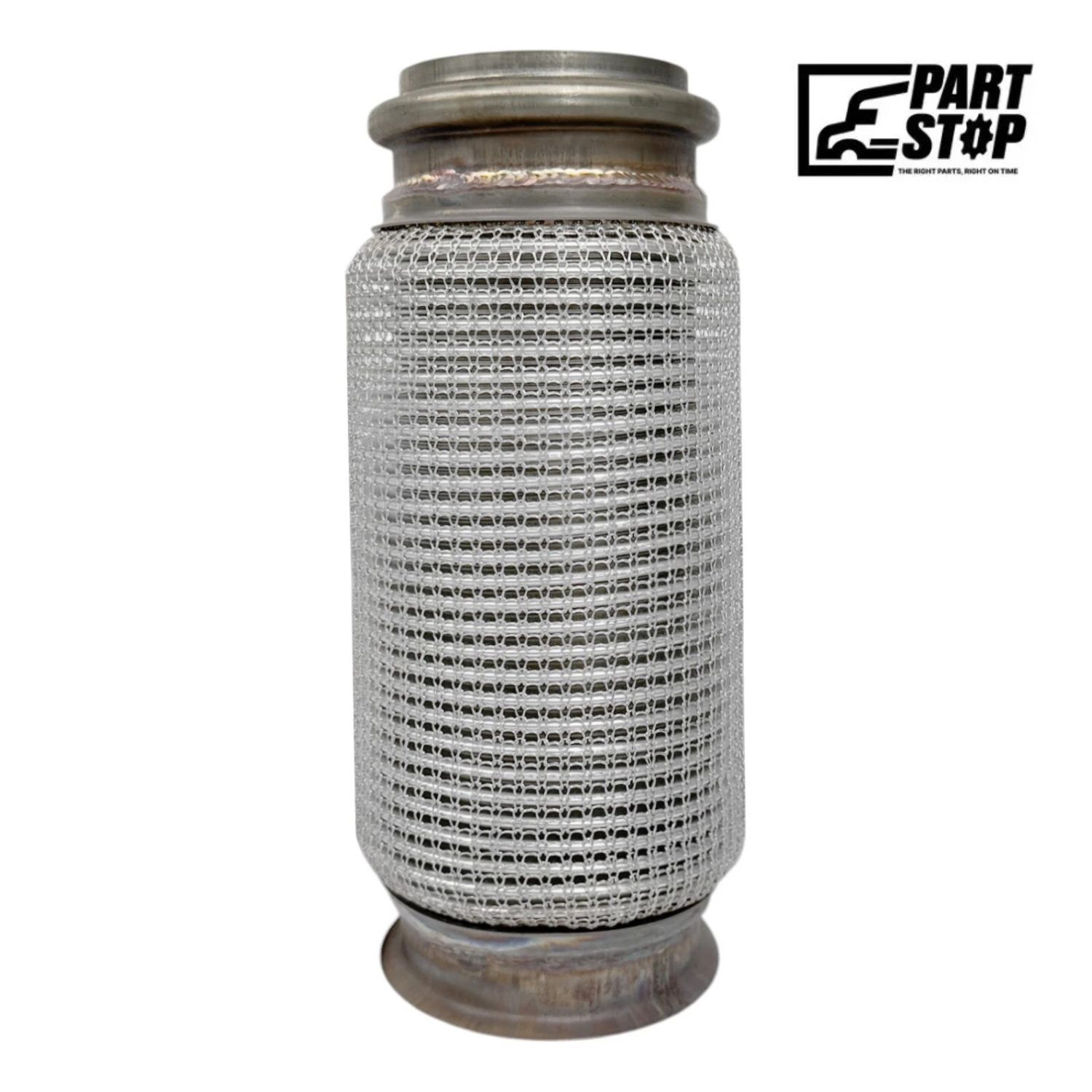
What This Flex Pipe Does
The flex pipe is the joint that lets the exhaust move while the engine rocks on its mounts and the frame twists under load. Without it, every torque pulse and road input goes straight into rigid pipe, clamps, and turbo housing. The bellows takes that movement instead. That is the whole job, and it is why the part wears out before the pipe sections around it do.
Construction is metal bellows with a stainless inner liner and outer braid. The liner keeps exhaust flow smooth through the convolutions so soot does not pack into the folds. The braid restrains the bellows from over-extending and takes the abrasion from road debris. Multi-ply bellows spread the flex across several layers instead of fatiguing one thin wall.
Failure is usually gradual. You get a hairline crack at a convolution root, then a soot trail, then an audible tick under load that goes away at idle. On trucks with aftertreatment, an upstream leak upsets sensor readings and can trigger regen faults. Replace the bellows before you start chasing sensors.
Why These Numbers Cross
820.B59541P is the number stamped or tagged on the assembly people are replacing. PN-3-B-021 is our internal cross-reference for the same physical part. They land on the same flex pipe because the dimensions that matter — bellows length, tube diameter, and end configuration — are identical, so the assembly drops into the same span between the two pipe sections.
Flex pipes cross on geometry, not on branding. If the overall length, the tube OD, and the end style match, the part fits the gap. Material grade and ply count affect service life, not fitment. That is why one flex pipe can carry several numbers across catalogs while the hardware around it stays unchanged.
Numbers from other manufacturers are listed here for identification only. PartStop is an aftermarket supplier and is not affiliated with, endorsed by, or authorized by any OEM. Treat the cross-reference as a starting point and confirm against your VIN or the number on the part you are pulling off.
Check Before You Order
Get the old part off, or at least get eyes and a tape on it. Measure the overall length of the flex section and the outside diameter of the tube ends. Note whether the ends are plain tube for clamps or flared. A flex pipe that is an inch off in length will fight you at install and load the bellows in tension from day one — which is exactly how the next one cracks early.
Look at what killed the first one. A broken or sagging exhaust hanger, a collapsed engine mount, or a muffler strap that has rusted through will put steady strain on the new bellows. Replace the supports at the same time. Also check the mating pipe ends for scale and pitting; a clamp will not seal on a rotten tube.
820.B59541P Cross-Reference & Interchange Numbers
These manufacturer and aftermarket numbers commonly cross-reference to 820.B59541P. Use them to identify the part — then confirm the exact fit by VIN or the number stamped on your old unit before you order. An interchange is a starting point, not a fitment guarantee.
| Brand / Line | Cross-Reference Numbers |
|---|---|
| Cross-Reference | PN-3-B-021 |
Frequently asked questions
How do I know the flex pipe is leaking and not a clamp?
Run the engine at fast idle and look for soot streaks. A clamp leak leaves a tight fan of black right at the joint. A bellows leak streaks along the braid or shows a fine white-grey line where the crack opens under heat. Cold-start ticking that softens once everything expands usually points at the bellows.
Will this fit my Cascadia without modification?
Cross-reference gets you to the right family of part, but it is not a fitment guarantee. Confirm with your VIN or by matching the number on the flex pipe you are removing, and measure overall length and tube OD before you commit. If your truck has had exhaust work done before, the current pipe may not be the factory configuration.
Can I weld a cracked flex pipe instead of replacing it?
You can tack a crack closed and it will hold for a while, but weld heat hardens the thin bellows wall and the next crack usually starts right beside the repair. Welding also stiffens the joint, which is the opposite of what the part is there to do. Replace it.
Not sure it fits? We check before you pay.
Run your VIN and we’ll match parts to your exact truck, or call the counter — a person who knows trucks verifies fitment by OEM number before the order ships. No wrong-box returns.
Engine parts hubs
This part runs on these engines — browse the full aftermarket parts range for each.
More cross-reference guides
Need the part, not just the reading?
Every part below is a Premium Quality aftermarket Direct Replacement with published OEM cross-reference numbers, a 6+ month warranty and same-business-day shipping from Tacoma, WA. Not sure it fits? Run your VIN — or call and a person who knows trucks will verify fitment before you pay.